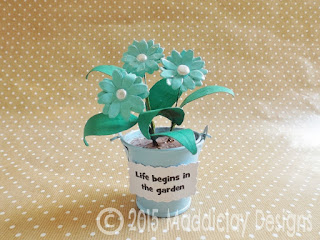
 Creating flowers with clay can produce some amazing result
that can add a permanent floral addition to your home or are perfect as a thank
you gift that will last forever.
Creating flowers with clay can produce some amazing result
that can add a permanent floral addition to your home or are perfect as a thank
you gift that will last forever.
There is an endless list of flowers that can be created and the more practice and experimentation the better your skills will be. There are lots of different types of clay that are perfect for flower sculpting. This post offers a few examples of the types of flowers that can be made with cold porcelain clay and stone based air dry clay using, a variety of techniques and tools.
Many clay products such as polymer and foam clay can be purchased pre-coloured. Stone based air dry clay’s are usually white, grey or terracotta. If you want to colour your clay there are two main techniques;
- Pre- cured - wet clay
- Post cured - dry clay
Colouring some stone based clay pre-cured doesn't always work well so it is important to experiment with a small piece of clay and colour pigments beforehand.
There are an abundance of pigments that can be used to add colour and shimmer to your creations. In addition to using tempura and acrylic paints, air dry clay can be coloured with marker pens, inks, chalks and dyes. Glitter glue and metallic powders can also be added for extra sparkle and great effects. Remember that air dry clay is porous and the finished creation should be sealed with a varnish.
Before adding a colourant to uncured clay knead the clay to soften it making it easier to accept the colour. Gradually add the colourant a small drop at a time, making sure you work it in fully before adding more. Continue adding a few drops at a time until you are satisfied with the shade. Colouring clay can be very messy so be sure to work over a surface that can be easily cleaned or thrown away, such as plastic sheeting or newspaper.
Creative play for children is an important part of any child’s development and growth, as it helps to increase their motor skills, imagination, concentration and cognitive capabilities. It will also help to increase the child’s hand eye co-ordination, planning and ability to follow instructions.
There are lots of things that you can do to encourage this, such as arts and crafts, drawing, painting, building bricks and clay work. All children love being active and when they are not able to get out in the fresh air then these activities are great and children can often be enthralled for hours.
Creative play and in particularly clay work, is an ideal medium for children that find it difficult to pay attention, sit still or communicate easily, such as ADHD (Attention Deficit Hyperactivity Disorder) or Autism. Clay enables the child to occupy their hands and provides a focus on something without having to look at someone directly and/or express their emotions and feelings in non-verbal communication. Clay work is often a favourite with play therapists and can been found in most therapeutic centres.
In order to preserve your beautiful creations it’s a good idea to
coat your clay in a glaze or varnish once it has been air dried, baked and/or
decorated. Some clay’s such as cold porcelain and stone air dry clay have to be
glazed to ensure it keeps out moisture and dirt. Other clay’s such as polymer
don’t always need to be glazed but by adding the right type of varnish it can
produce a professional finish or shine to your creation.
There are many different brands including Fimo, Sculpey, Gedeo
and many others, which all offer different finishes for your clay work.
Some leave a matt finish others a satin finish and others a glossy finish. Not
to mention the different sizes and prices of each product. If you use the wrong
type of varnish the finish may look fine to start with but could soon start to
peel or become sticky later. Others may start yellowing or cause the paint or
clay to react and loose the colouring.
Cold Porcelain is similar to most air dry clay’s and is great for
making different clay projects, especially flower sculptures, jewellery,
figurines and cake toppers. It is also great to use with moulds as it retains
fine detail and is easy to remove from the mould. It is now becoming more and
more popular with professional clay artists and craft people. It is also a great craft clay to use for beginners for their clay art projects.
This
clay is perfect for making delicate flowers and petal sculptures as it can be
stretched and rolled extremely thin, which results in very realistic looking
floral effects.

